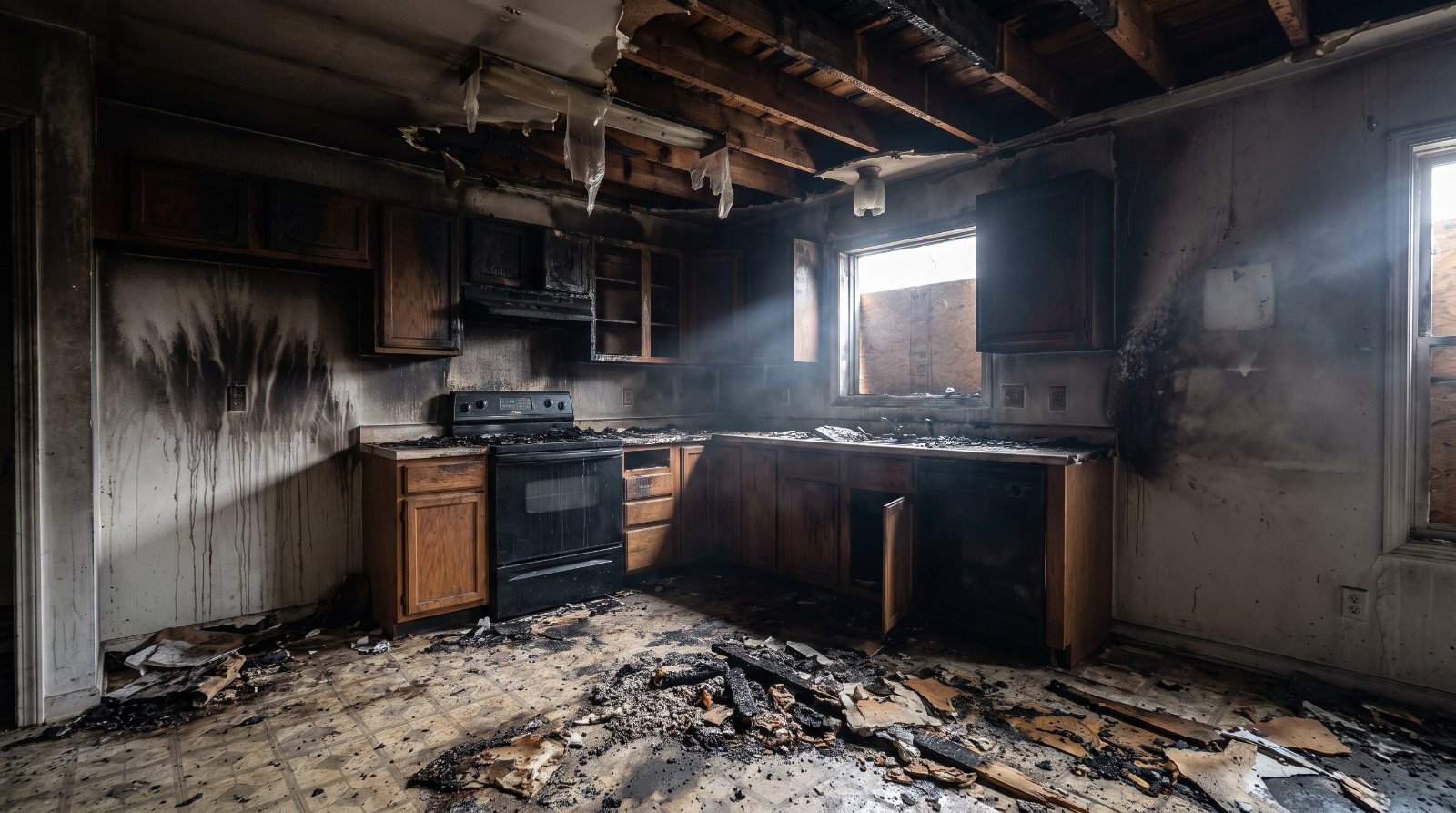
The instinct after a fire is to start cleaning. It is the worst thing you can do in the first twenty-four hours, and it permanently costs people money.
What soot actually is
Soot is not dust. It is a residue of unburned carbon particles carrying whatever chemistry came out of the materials that burned — and in a modern house that means plastics, foam, adhesives, synthetic textiles and finishes. The particles are extremely fine, they are usually acidic, and they are abrasive.
That combination is why time matters. Acidic residue sitting on a surface etches it. Glass, chrome, stainless, aluminium window frames, appliance finishes, and porcelain fixtures start taking permanent damage within hours, not weeks. Cleaning the residue off is straightforward; reversing the etching underneath is not possible.
Why wiping makes it worse
Because the particles are fine and abrasive, dragging a cloth across them grinds them into the surface. On a porous surface — painted drywall, unfinished wood, upholstery, carpet — you push the residue below the surface where no subsequent cleaning can reach it. What was a removable film becomes a permanent stain.
Adding a household cleaner or water usually compounds it. Many soot residues are handled dry, with specialised sponges and vacuums, precisely because moisture turns the particles into a smear that sets. Professional soot removal is matched to the residue type and the surface, and getting that pairing wrong is what turns a cleanable wall into one that has to be sealed and repainted.
If soot residue is sitting on glass, chrome or a metal appliance finish and it will be more than a day before anyone can get to the property, gently lifting it with a dry, soft cloth — no pressure, no cleaner, no water — is better than leaving acid on metal. Everywhere else, leave it alone.
What not to do in the first day
The water is often the bigger job
Homeowners are frequently surprised by this. The fire department put a large volume of water into the structure in a short time, and that water went everywhere fire suppression water goes — through ceilings, down wall cavities, into insulation, under flooring, into the level below.
So a fire loss is usually a water damage job running simultaneously with a soot and odour job. If the water is not extracted and the structure dried on the normal water-loss timeline, you get microbial growth on top of the fire damage inside twenty-four to forty-eight hours. This is why securing and drying the building happens in the first hours, before any cleaning conversation.
Why board-up matters more than it sounds
Odour: what actually removes it
Smoke odour bonds into porous materials — drywall, insulation, carpet pad, upholstery, and bare framing. The only reliable sequence is physical: remove what holds the odour and cannot be cleaned, clean what can be, then treat the air and seal the remaining structure.
Fogging or ozone treatment on its own, without removal, is the shortcut that fails. It suppresses the smell for a while, and then it returns on the first warm humid day, usually about the time the homeowner has moved back in and repainted.
Contents should be inventoried and photographed before anything moves, then packed out for cleaning and storage while the structure is worked. Textiles, electronics and hard goods each take a different process. Anything not salvageable should be documented for your claim rather than quietly discarded — a ruined item with no photograph is a line item you may not be paid for.
The first-day list
Fire in the last 24 hours?
Board-up and documentation the same night. Call before you clean anything.